Vortex Flow Meter
Reliable liquid, gas, and steam flow measurement featuring no moving parts, low power consumption, high pressure/temperature tolerance, and wide turndown range.
Vortex Flow Meter Overview
Vortex flow meters offer many advantages for flow measurement including easy installation without impulse lines, no moving parts to maintain or repair, less leak potential and a wide flow turndown range. Vortex meters also offer very low power consumption, allowing for use in remote areas. Additionally, Vortex meters are unique in that they can accommodate liquids, gasses, steam and corrosive applications. Vortex flow meters are also able to withstand high process pressures and temperatures.
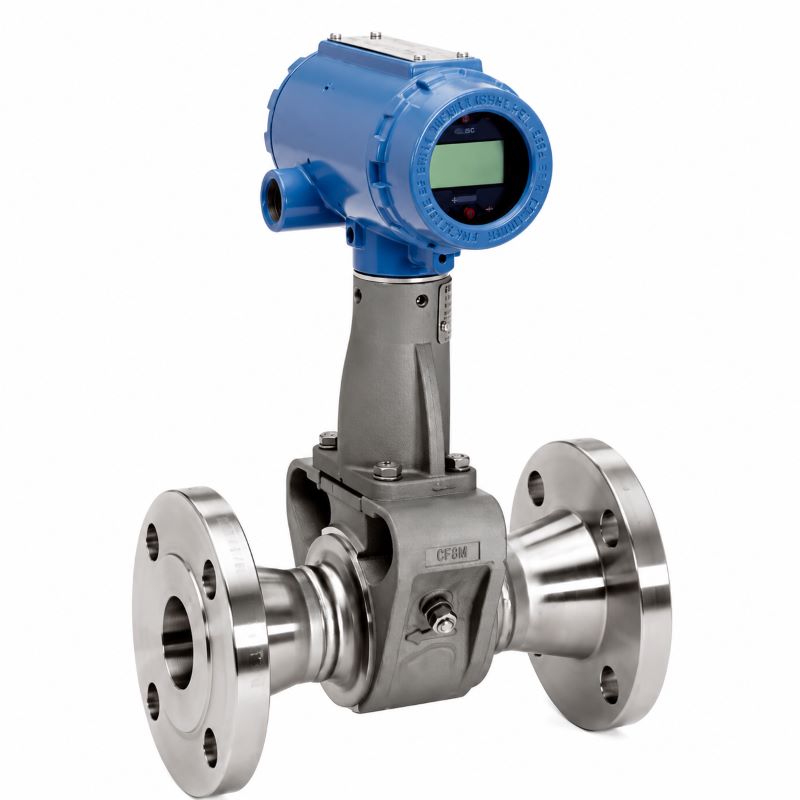
Vortex Flow Meter
Feature
- It supports higher range
- It is very simple in construction.
- It works well for both liquids and gases.
- It does not require complex pressure impulse lines.
- It is less sensitive to wear.
- It does not require need for compensation of fluid density in volumetric flow measurement.
Application
Different media solutions, such as liquid, or gas, can affect the capability of the vortex flow meter. Liquid - Liquids with heavy particle suspensions will wear down or clog internal parts, such as the bluff body, causing flow meter errors. Vortex flow meters struggle with liquids that have a high viscosity since they tend to dampen the formation of vortices and reduce the effective range. Particles and internal bubbles do not usually affect vortex meters. Most manufactures are calibrated for liquids of 1 cST viscosity. Anything above that will raise the minimum readable flow rate, reducing rangeability. Gas- Gas is compressible and changes volume when placed under pressure, heated, or cooled. For systems where gas is the primary media, the vortex flow media should have sensors which monitor changes in temperature and pressure in the system.
Expertise Across Major Process Industries
Tailored industrial control panels, process instrumentation, VFD drive automation & turnkey repair services engineered for critical operating sectors worldwide.